
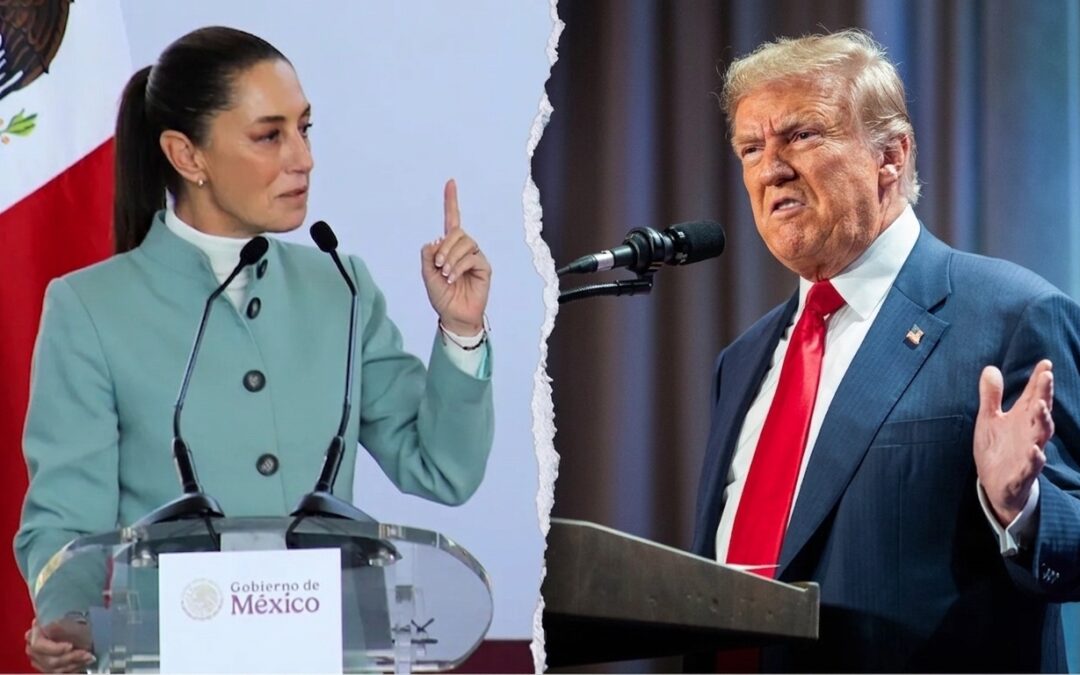
There are moments in politics when you can feel a relationship changing beneath your feet. Not with a single dramatic explosion, but through a series of calculated moves that, taken together, reveal something that cannot be undone. What is happening right now between Mexico and the United States is one of those moments.
For decades, the two countries operated under an unspoken deal: cooperate just enough on security, keep the trade flowing, and don’t push too hard on each other’s internal affairs. That deal is gone. Not broken in a single moment, but quietly dismantled, piece by piece, until one day you look up and the rules of the relationship have changed entirely.
When the Los Angeles Times reported that the U.S. government is investigating Alfonso Durazo, governor of Sonora, and Américo Villarreal, governor of Tamaulipas, both stripped of their visas and both pulled into the legal orbit of Washington’s justice system, it wasn’t just another drug war headline. It was a message. The United States has decided it can reach inside Mexico’s political class and start sorting who is trustworthy and who is not. That is a different kind of pressure than what we have seen before. It is not about cartels hiding in the mountains. It is about sitting governors, elected officials, being treated as potential witnesses, or worse, suspects, in American federal courts.
Mexico-U.S. Relations in 2026: Three Stories That Are One
AMLO reemerging from his ranch in Palenque to write a letter defending Sheinbaum and accusing Trump of plotting against Mexico’s left, Sheinbaum standing at a rally telling her supporters that Mexico is not anyone’s piñata, and Trump’s administration simultaneously threatening not to renew the USMCA trade agreement, these look like separate stories. They are not. They are three pressure points on the same body.
What Washington is doing is connecting dots that Mexico has long tried to keep apart: cartel violence, political corruption, border security, and trade. Once those dots are fused in American political discourse, Mexico does not just have a security problem. It has a legitimacy problem. And a country with a legitimacy problem in Washington’s eyes is a country that loses negotiating power very fast.
The election calendar nobody talks about
The honest answer for why this is happening now involves something as unglamorous as election calendars. In November 2026, Americans vote in midterm elections, every seat in the House of Representatives and a third of the Senate. Trump needs to arrive at those elections looking strong on border security, tough on cartels, and in command of the narrative around crime and sovereignty.
Mexico is useful for that story. A governor under investigation, a former president writing defensive letters, a sitting president pushing back on meddling, all of it feeds a narrative about a man who holds firm and does not blink. That is worth something to Trump’s base, and he knows exactly how to use it.
The quieter fight over trade
While the political drama plays out loudly in public, the trade negotiations are where the real leverage sits quietly. The USMCA review process is already underway, with bilateral rounds in May and another scheduled in Mexico City in July. Trump has signaled he will not agree to a full 16-year extension, preferring a shorter rolling review that keeps Mexico perpetually uncertain.
That is not just trade policy. It is a pressure tool. An uncertain trade future chills investment, shakes supply chains, and forces Mexican negotiators to be more accommodating on security and political demands just to preserve economic stability. Mexico enters that room already carrying a public scandal and an open confrontation with Washington. That is not a strong negotiating position.
The corner Sheinbaum is standing in
Claudia Sheinbaum is navigating one of the most difficult political terrains any Mexican president has faced in decades, and she is doing it without a clean exit in any direction.
If she fully defends Durazo and Villarreal, Washington frames her as protective of figures tied to organized crime. If she distances herself from them, she fractures Morena’s internal coherence and signals to every governor in the country that the presidency will not protect them when the pressure comes. And if she cooperates too visibly with American demands, she hands the opposition a devastating argument: that Mexico’s sovereignty is a performance, not a reality.
AMLO’s letter was meant to help steady the ship, but it also unintentionally confirmed how much the ship is rocking. You do not call in the founder unless things are genuinely uncertain.
What comes next
My forecast is not a dramatic one, and that is precisely what makes it serious. I do not see a full rupture. The economic interdependence between the two countries is too deep and too immediate for either side to walk away from. What I see instead is something more insidious: a relationship that continues to function on the surface while becoming increasingly unequal underneath.
Mexico will cooperate more than it publicly admits. Washington will take those concessions as victories and ask for more. The language of sovereignty will remain loud, while the practice of sovereignty quietly narrows. And the people who will feel it most are not the governors or the presidents. They are the families in Michoacán and Oaxaca whose remittances flow through financial systems now under growing scrutiny, and the factory workers in Sonora whose livelihoods depend on a trade agreement that may or may not survive the year.
The bigger truth
What we are watching is not a crisis that will peak and resolve cleanly. It is a transition from a relationship built on strategic tolerance to one built on conditional compliance. The United States is no longer willing to look the other way in exchange for stability. It wants results, on its terms, and it has enough tools, legal, financial, commercial, and diplomatic, to make the cost of non-compliance very real.
Mexico is not powerless, but it is more exposed than it has been in a long time. The question going forward is not whether it can maintain its sovereignty in theory. It can, and it will insist on it loudly. The real question is whether it can hold on to it in practice, in the room where pressure peaks and the clock is running toward November.
Related reading:
Could Mexico Solve the U.S. Egg Crisis?, A case study in what happens when USMCA meets real-world supply chain pressure.
Expanding Your Mexican Business to the U.S.: The 5 Decisions That Matter, Operating across the border requires understanding the political environment, not just the trade rules.
Krear Consultancy · Scottsdale, Arizona · Mexico City
Last reviewed: June 2026
Explore Our Services: Mexican Citizenship · Our Services · North American Market Entry · Workforce & Talent Relocation · Travel Advisory
Krear Consultancy
Ready to find your path?
Whether it is Mexican citizenship, U.S. business setup, or a cross-border move, your first consultation is free.
Book a Free Consultation